November 2026
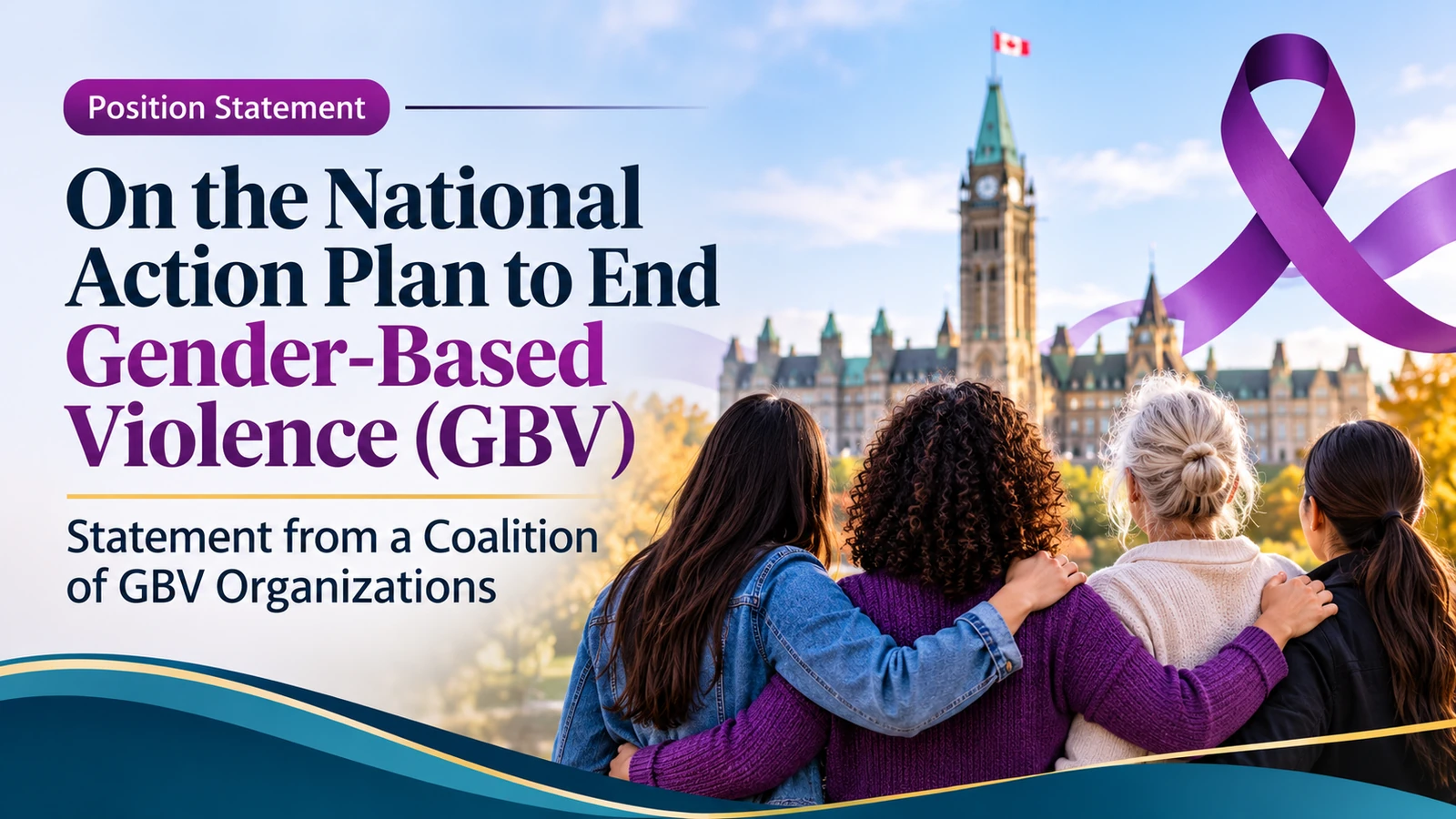
The announcement of $607.4 million in July 2026 to continue the National Action Plan to End Gender-Based Violence (NAP) has been a cause for celebration. The gender-based violence (GBV) sector has been advocating for the continuation of both the funding and the plan over recent years, and we are excited to not only see this announcement, but also the increase in funding from the first phase of implementation of the plan. This speaks to both the federal government's commitment to addressing GBV and the power of collective advocacy.
The NAP, announced in November 2022 after more than a decade of advocacy by GBV organizations and experts from across the country, fulfilled an international commitment to have a national plan to address GBV. Emerging from sustained advocacy and expertise from survivors, frontline organizations, Indigenous leaders and GBV advocates, the promise of this plan was to ensure that every survivor in Canada had the necessary support and services to fully heal from the trauma of GBV. The current outline was negotiated and launched by federal, provincial and territorial governments. Implementation and funding allocation in its first phase have raised the profile of GBV in Canada. Discussions and awareness of GBV have increased, particularly in the media. The NAP also activated new funding streams, enabling ongoing support and the emergence of several new initiatives.
We continue to be hopeful and reassured by the announcement of renewed investments in the NAP, building on the successes of the first implementation phase. During this phase, both the federal government and the provinces and territories invested in recognizing and addressing femicide, technology-facilitated GBV, financial abuse, traumatic brain injury, and coercive control. Given the work left to do, and the rise in femicide rates, increased wait lists for services, overcapacity at shelters and perpetrators’ misuse of new technology, there is an opportunity to further address GBV in the ways we outline below.
1. We ask the government of Canada for full accountability and transparency in the next five years of the NAP.
The first phase of the NAP suffered from a general lack of transparency and accountability. The full bilateral agreements have never been made publicly available, and the annual list of actions (Schedule B) and cost-sharing budget (Schedule C) are available for the first two years only and have not been released in a timely way. To date, Schedules B and C have not been released for 2025/26 or 2026/27 for any province or territory, and they have not been released for 2024/25 for Ontario and Newfoundland and Labrador. In addition, because Alberta and Quebec have unique accountability expectations, it is impossible to access any details of their actions or cost-sharing.
1.1 We call for the regular, timely, predictable production of annual reports and reliable reporting timelines.
The lack of transparency about how funds are allocated and what actions they support makes it difficult to see progress on the NAP. While there is a general description of where the funds are allocated, annual reports must be produced in a timely manner and contain detailed information. For example, some sections refer to the number of resources, but they do not describe what kinds of resources are available, how they are used, or who accesses them. Greater accountability through sharing the annual allocation list as well as up-to-date production of annual reports and reporting timelines will more effectively engage civil society in a nationwide effort to scale successes and address gaps together. The NAP GBV is an amazing opportunity to develop a cross-Canada portrait of efforts to end GBV and to find innovative ways that could be scaled and adapted.
1.2 We ask for the creation of a GBV Commissioner with ombudsperson-like powers.
A GBV Commissioner would not only bring greater oversight to the NAP, but also to GBV as a whole, including monitoring Canada’s compliance with international agreements like CEDAW. Having such an office would also strengthen engagement with the GBV sector at the national level.
1.3 We need improved accountability frameworks that help see how data is rolled up from the provinces related to the funding invested.
While we understand these data cannot be disaggregated in some respects to safeguard confidential information, it would be beneficial for data to be separated out across pillars, types of investment, and individual actions either across the whole country or by province/territory. In order to track investments in real time, planned spending for every action in the agreements, pillar by pillar, should be shared going forward along with timelier public-facing communication like reports and action plans, and the signed bilateral agreements. Provincial and territorial governments should demonstrate what direct-service capacity was created or sustained, including the number and type of frontline positions and services funded, their geographic reach, and whether access and wait times improved.
2. We call for more predictable, multi-year funding including administrative costs that fills important service gaps, in particular to ensure sexual assault crisis organizations are no longer excluded.
As service providers face heightened demand, we require stable funding to maintain critical supports. This would enable service providers to focus on their mission rather than the operational stresses these arrangements create for staff. The increase in resources to the Canada-wide GBV sector is positive, but we are concerned about the project-based funding protocol outlined in Schedule B. Project-based funding strategies constrain capacity in several ways: by restricting organizational responsiveness in times of emerging or urgent needs; by imposing a higher administrative burden on organizations; and in generating worker precarity when there is no long-term horizon for dependable and sustainable funding. Across regions, we require funding consistency organized in accordance with national priorities, including explicit support for sexual assault crisis centres; regional, rural, remote and northern access; and support for Indigenous-led and other by-and-for organizations.
2.1 We call for multi-year, comprehensive funding models for GBV service providers, including coverage of administrative costs.
2.2 We call for sexual assault crisis centres to be named as an explicitly designated funding stream.
3. We ask for true engagement and consultation with the survivors and GBV organizations.
Engaging with the service providers on the ground most connected to survivors of GBV, whether shelters, sexual assault crisis centres, community services, or GBV organizations, provides all levels of government with tactical and timely information on what is most needed, as well as what the successes have been to date. However, engagement within provinces and territories has been very mixed. While some regions, like PEI, have formed government advisory tables and actively sought input from organizations, much of the sector has not been adequately consulted. Similarly, at the national level, organizations have been brought together infrequently as an opportunity for information to be shared with them, without a meaningful space for engagement and provision of feedback. This is another lost opportunity to build a truly integrated GBV plan that includes all services.
Creating a formal role for frontline GBV organizations in implementation and decision-making, including priority-setting, funding design, monitoring, and evaluation would help ensure sector expertise is in place before decisions are made.
We need planned and scaled consultations carried out with civil society based on gathering both concrete ideas and significant feedback. A yearly schedule, outlining what will be asked of organizations and when, as well as alignment with the pillars of the plan is essential. We need to co-create a clear plan on how our consultations and suggestions move ahead with the government. Engagement must be connected to action, so the sector can see recommendations move through the government. This is a clear way to track systemic change.
3.1 We call for a published, annual consultation schedule, co-created with GBV civil society organizations, outlining what will be asked of the sector and when, with clear alignment to the NAP's pillars.
3.2 We call for a formal feedback loop connecting consultation to action. Such a mechanism would clearly demonstrate how the government is engaging with sector recommendations.
4. We call for a greater focus on the national opportunities to address GBV.
When the NAP was tabled, it was heralded as a joint effort, including all Canadians with a vision to live in a Canada free of GBV. This is a shared vision and responsibility. Yet the Canadian plan continues to be fragmented. By signing bilateral agreements and distributing nearly all funds to the regions, there is little ability to implement national projects. There are examples of projects being implemented at the provincial or territorial level that could be valuable nationally, yet we continue to fragment the funds and therefore the potential impact of the NAP.
While the provinces and territories face unique challenges, there are commonalities across the country in the rates and experiences of GBV. By addressing this in a piecemeal way, we are losing opportunities for collaboration and knowledge sharing. This also contributes to the ongoing challenge of survivors experiencing vast variability in policy, services, programs, and supports as they move throughout the country.