
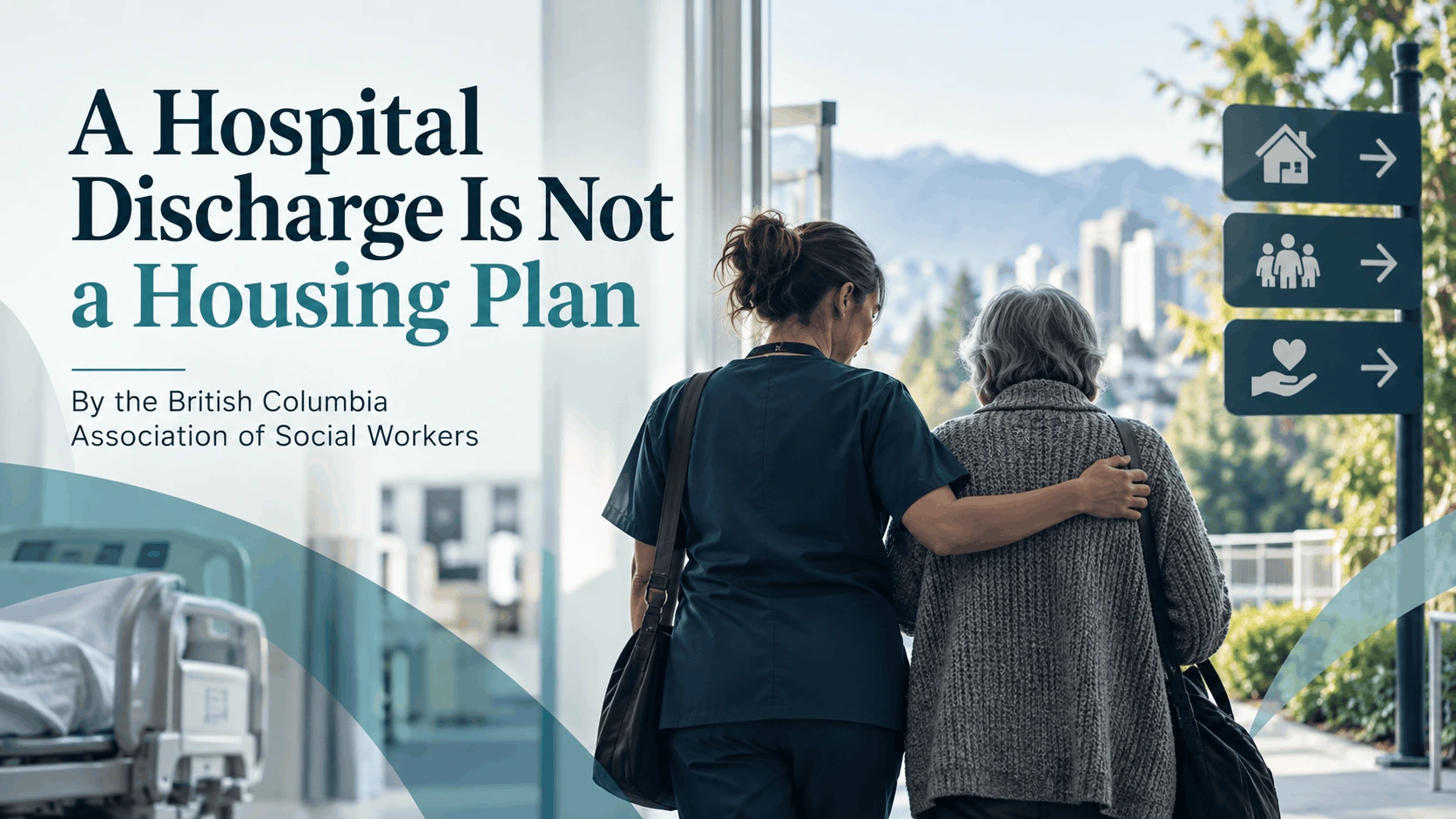
When a person is medically ready to leave hospital but has nowhere safe or appropriate to go, we need to be clear about what has happened. The medical system may have completed one part of its work, but our collective responsibility to that person has not ended.
Across British Columbia, hospital social workers confront this reality every day.
They work with older adults, people living with disabilities, people experiencing homelessness, people with mental health and substance use challenges, and people whose health has deteriorated alongside poverty and housing instability. Their role is to help patients and families navigate extraordinarily complicated circumstances and to build the safest possible path from hospital back into the community.
But social workers cannot create housing where none exists. They cannot manufacture supportive care spaces, shelter beds, home supports or community services that are unavailable. And they cannot solve, one patient at a time, social problems that have been allowed to grow for decades.
When the resources needed for a safe discharge do not exist, discharge planning can become something very different: the management of scarcity.
For social workers, that creates profound ethical tension.
BCASW heard this clearly when we surveyed social workers working in acute health care settings for our 2021 report, Bus Tickets Are Not Enough. Respondents described pressure to facilitate discharges when suitable housing or supports could not be found. They spoke about stress, frustration, hopelessness and, importantly, moral distress. Moral distress can arise when a professional knows what a person needs, but is unable to provide it because of circumstances beyond their control.
Moral distress is more than workplace frustration.
Social workers are guided by professional obligations that include protecting the dignity and well-being of the people they serve and advocating for change when systems are failing them. When a social worker believes that an older adult, a person with a disability, or another vulnerable patient requires a safe and supported environment, yet the available choices amount to a shelter, homelessness, an unsafe living situation or remaining indefinitely in an acute care bed, there may be no genuinely good option to choose.
That is not a failure of individual social workers.
It is evidence of a gap between the systems we have built and the needs of the people those systems are supposed to serve.
Hospitals cannot become permanent housing. Acute care beds are desperately needed, and keeping someone in hospital after they no longer require acute medical treatment carries its own risks. Shelters, meanwhile, perform essential work under enormous pressure, but emergency shelters were never intended to substitute for appropriate housing, long-term care, assisted living, rehabilitation, mental health care or other forms of specialized support.
When the only choices are inappropriate ones, transferring a person from one overstretched system to another does not resolve the underlying problem. It relocates it.
We also need to challenge the artificial separation we have created between health and social conditions.
A person may be medically stable enough to leave a hospital bed while still being profoundly vulnerable. Recovery does not occur in a vacuum. Where someone sleeps matters. Whether they can safely use a washroom matters. Whether they can store and take medication matters. Whether they can obtain food, attend follow-up appointments, manage mobility limitations and reach help when their condition changes all matter.
Housing is therefore not an issue that begins when health care ends.
It is part of the conditions that make health possible.
Our 2021 report called for more affordable and supported housing, stronger coordination between hospitals and community agencies, greater recognition of social needs as determinants of health, and improved access to primary care for people experiencing homelessness. Five years later, these questions remain urgent.
British Columbia needs a stronger continuum between acute health care and the community.
That should include clear standards for discharge when patients face homelessness or other serious vulnerabilities; appropriately resourced transitional and supportive housing; better coordination among health authorities, housing providers and community organizations; adequate home and community supports; and discharge pathways designed specifically for older adults and people with complex health and social needs.
It also means properly supporting the professionals being asked to navigate these situations.
Hospital social workers need manageable workloads, meaningful involvement in discharge decisions and the ability to raise concerns about unsafe or inappropriate plans without being expected to somehow resolve structural shortages on their own.
When social workers repeatedly experience moral distress because the resources necessary to practise according to their professional values are unavailable, we should not normalize that distress as simply part of the job. We should treat it as information.
It tells us something about the system.
We must also resist the temptation to search for a single person or profession to blame whenever an unacceptable outcome becomes visible.
A social worker cannot solve the housing crisis from a hospital office. A nurse cannot create a supportive housing unit. A physician cannot open a long-term care bed. A shelter worker cannot transform an emergency shelter into a health care facility.
Yet at the point of discharge, all of the consequences of shortages elsewhere in the system can converge in one room, around one patient, with professionals and families being asked to make decisions among options that nobody considers acceptable.
The answer cannot simply be to become better at choosing among bad options.
We need better options.
BCASW believes social workers have an important perspective to contribute to that work. Our profession sees how health, poverty, housing, disability, aging, family support and community services intersect in people's actual lives. We see both the dedication within our public systems and the cracks between them.
British Columbia should be a province where leaving hospital means moving toward recovery, stability and safety, not simply leaving a bed because the health care portion of a much larger human problem has been declared complete.
A discharge destination should be more than somewhere a person can be sent.
It should be somewhere they can safely go.